


The best AI collaboration platforms help teams find information, understand context, and complete work across the tools they already use. Unlike standalone chatbots or project management software, these platforms connect company knowledge with AI assistants, agents, and workflow automation.
The leading AI collaboration platforms for enterprise teams in 2026 are:
- GoSearch — Best for enterprise search, AI agents, and cross-system workflow automation.
- Glean — Best for enterprise knowledge discovery across a large technology stack.
- Microsoft 365 Copilot — Best for organizations standardized on Microsoft 365.
- Asana — Best for project management with AI-powered planning and task insights.
- ClickUp — Best for teams that want project management, docs, and automation in one workspace.
- monday.com — Best for visual project planning, resource management, and team workflows.
- Slack — Best for AI-assisted communication, summaries, and knowledge discovery inside team conversations.
- eesel AI — Best for AI support agents that work inside your existing helpdesk.
The right choice depends on whether your primary need is enterprise search, project execution, team communication, workflow automation, or a combination of all four.
Enterprise search alone doesn’t move work forward — organizations need agents that act on what they find. Deloitte’s 2026 State of AI in the Enterprise report found that 66% of organizations report productivity and efficiency gains from AI, and GoSearch customer Model N saw even sharper results — a 47% productivity boost in customer support after deploying agents to monitor tickets, pull context, and auto-draft responses. The platforms that win combine three capabilities: finding answers across your tools, understanding the context, and taking the next step automatically.
AI Workplace Assistants vs. AI Collaboration Platforms
An AI workplace assistant, or AI copilot, answers questions and drafts content for one person. An AI collaboration platform works across all of a company’s connected apps and also takes the next step, like updating a record, opening a ticket, or posting a summary to a channel. Buyers often shortlist tools from both groups. Here’s how the most common assistants stack up.
| Assistant | Best for | Company data it reaches | Workflow actions |
|---|---|---|---|
| ChatGPT Enterprise | Drafting, analysis, and research | Apps for Google Drive, SharePoint, Slack, GitHub, Gmail, and custom MCP servers, enabled by admins | Agent mode; write actions controlled by admins |
| Microsoft 365 Copilot | Organizations standardized on Microsoft 365 | Microsoft 365 content plus Copilot connectors for tools such as HubSpot, Notion, Jira, and Confluence | Assistance inside Word, Excel, Outlook, and Teams; Copilot agents |
| Gemini Enterprise | Google Workspace organizations | Google Workspace plus connectors for Confluence, Jira, SharePoint, and ServiceNow | No-code agents and prebuilt Google agents |
| Notion AI | Teams whose documentation lives in Notion | Notion plus connectors for Slack, Teams, Google Drive, Jira, GitHub, and SharePoint (Business and Enterprise plans) | Drafting and reports inside Notion |
| Slack AI | Teams that coordinate in Slack | Slack conversations plus connected apps such as Google Drive, Confluence, and Salesforce (enterprise search on Enterprise+) | Recaps, summaries, and Slack workflows |
| GoSearch | Teams that need one assistant to search, summarize, and act across company apps | 100+ apps through indexed, federated, and MCP connectors | No-code agents and multi-step workflows that query one system and update another |
Each assistant above works best inside its own ecosystem. GoSearch is built for companies whose knowledge spans several, such as Slack, Google Drive, Confluence, Jira, and Salesforce. Employees ask one question, get a sourced answer, and trigger the follow-up task from Slack, Teams, the browser extension, or the web app.
Compare AI Collaboration Platforms by Use Case
Use this table to match each AI collaboration platform to the job you need done: finding information, summarizing it, or acting on it across apps.
| Platform | Primary use case | Apps covered | Search and summarization | Workflow actions | Pricing model |
|---|---|---|---|---|---|
| GoSearch | Search, summarize, and act across company apps | 100+ apps via indexed, federated, and MCP connectors | Cross-app search with sourced answers | No-code agents; multi-step workflows across systems | Free plan; Pro at $20/user/month; Enterprise quote-based |
| Glean | Enterprise knowledge discovery | Broad connector library | Cross-app search, answers, and knowledge graph | Agent builder | Per user, quote-based; no public pricing |
| Microsoft 365 Copilot | AI inside Microsoft 365 | Microsoft 365 plus Copilot connectors | Summaries across Microsoft 365 content | Copilot agents; Microsoft workflow tools | Per-user add-on to a Microsoft 365 plan |
| Asana | Project and task management | Asana plus integrations | Project status summaries | Rules and task automation in Asana | Per seat, plus AI Studio credits |
| ClickUp | All-in-one work management | ClickUp plus integrations | Summaries and writing inside ClickUp | ClickUp automations | Per seat; AI is a per-seat add-on |
| monday.com | Visual planning and resource management | monday.com plus integrations | Summaries inside boards | Board automations | Per seat, plus AI credits |
| Slack | Team communication | Slack plus connected apps (Enterprise+) | Channel recaps; enterprise search on Enterprise+ | Slack workflows | Per user; Enterprise+ quote-based |
| eesel AI | AI support agents in the helpdesk | Zendesk, Freshdesk, Gorgias, Front, and Slack | Answers from help docs and past tickets | Ticket replies and escalation | Pay per task; no seats |
Example Buyer Scenarios
A large company on Slack, Google Workspace, and Confluence. Slack AI covers all three on Enterprise+, and Gemini Enterprise suits Google-first teams. Choose GoSearch when employees also need to act on answers, such as opening a Jira ticket from a Slack thread. See how the GoSearch Slack integration works.
An IT team replacing legacy intranet search across Teams, SharePoint, and Slack. Microsoft 365 Copilot handles Teams and SharePoint well. If Slack and non-Microsoft tools hold key knowledge, shortlist GoSearch or Glean, which connect both ecosystems and respect each source’s permissions.
An operations or HR team that needs to find a policy, summarize it, and assign a follow-up. GoSearch does all three in one workflow, and Asana or monday.com tracks the task afterward. Support teams working in a helpdesk can use eesel AI for ticket replies.
What Is an AI Collaboration Platform?
An AI collaboration platform is software that combines team communication, enterprise search, knowledge management, and workflow automation. It helps employees find information across business applications, understand the surrounding context, and complete follow-up work without manually switching between systems.
Enterprise search finds information; an AI collaboration platform finds it, summarizes it, and acts on it. To compare enterprise search vendors on their own, see our AI enterprise search guide.
A typical AI collaboration platform can:
- Search documents, messages, tickets, CRM records, and project data.
- Summarize information from multiple sources.
- Answer questions using company-specific knowledge.
- Draft emails, reports, project updates, and customer responses.
- Create tickets, update records, or route work to the right team.
- Apply existing permissions so employees see only information they are authorized to access.
The category overlaps with several other software categories, including AI workplace assistants, enterprise search platforms, project management tools, knowledge management systems, and workflow automation products. The key difference is that an AI collaboration platform is intended to connect these activities rather than solve only one of them.
For example, a traditional search tool may help an employee find a support policy. An AI collaboration platform can find the policy, summarize the relevant section, identify the customer issue, draft a response, and create a follow-up task.
How AI Collaboration Platforms Differ From Related Tools
AI collaboration platforms overlap with several established software categories, but their primary purpose is broader than any single category.
| Category | Primary purpose | Typical limitation |
|---|---|---|
| Enterprise search | Find information across company systems | May return information without completing follow-up work |
| Project management software | Plan and track structured work | Usually focuses on tasks already defined in the system |
| Team communication software | Help employees communicate and coordinate | Knowledge may remain buried inside conversations |
| Knowledge management software | Store and organize documented information | May not connect knowledge to operational workflows |
| Workflow automation software | Move data and trigger actions between tools | Often lacks broad organizational context |
| AI collaboration platform | Find, understand, and act on knowledge across tools | Requires careful evaluation of security, permissions, and integrations |
The categories are not mutually exclusive. A mature enterprise may use project management software for planning, Slack or Microsoft Teams for communication, a knowledge base for documentation, and an AI collaboration platform to connect information across these tools.
Project management tools handle structured project work; an AI collaboration platform connects knowledge and automates routine work across them.
How We Evaluated AI Collaboration Platforms
We evaluated these platforms against the capabilities that matter most to enterprise teams:
- Knowledge access — Can employees search across the systems where company information actually lives?
- AI assistance — Can the platform summarize, explain, draft, and answer questions using relevant context?
- Agent and workflow capabilities — Can it complete multi-step work instead of only returning an answer?
- Integration coverage — Does it connect to the applications used by teams across the organization?
- Security and permissions — Does it respect source-system access controls and provide appropriate administrative controls?
- Ease of adoption — Can employees use it within familiar workflows without extensive process changes?
- Reporting and governance — Can administrators monitor usage, outcomes, permissions, and workflow activity?
- Best-fit use case — Is the platform strongest for enterprise search, project management, communication, automation, or a combination?
No platform is the best choice for every organization. A project management tool may be the right choice for a team focused on deadlines and dependencies, while an enterprise search and agent platform may be better for a company trying to connect knowledge across many systems.
8 AI Collaboration Platforms Compared: Strengths and Best Fit
GoSearch: Best for Enterprise Search, AI Agents, and Workflows
GoSearch is designed for teams that need to search organizational knowledge and take action across multiple business systems. It combines AI-powered enterprise search, chat, custom agents, and multi-step workflows in one platform.
Best for:
- Teams with information distributed across many applications.
- Organizations that want no-code AI agents.
- Cross-functional workflows involving systems such as Slack, Jira, Salesforce, Notion, Google Drive, or other connected tools.
- Businesses that need answers grounded in company data before an action is taken.
Key capabilities:
- Search across 100+ connected workplace applications through indexed, federated, and MCP connectors (see integrations).
- Ask questions in natural language and receive source-backed answers.
- Configure agents for department-specific tasks.
- Run workflows that query one system and update another.
- Generate reports, documents, spreadsheets, and presentations from company knowledge.
- Apply source-system permissions to enterprise search and agent activity.
Choose GoSearch when: your primary problem is not simply finding information, but connecting knowledge to the next step in the workflow.
That’s the shift from search that surfaces answers to AI agents that act on them.
Glean: Best for Enterprise Knowledge Discovery
Glean focuses on enterprise search, organizational context, and knowledge discovery across a broad set of workplace applications. It is a strong fit for large organizations that want employees to find documents, conversations, experts, and internal answers from a central search experience.
Best for:
- Large organizations with fragmented internal knowledge.
- Teams prioritizing enterprise-wide discovery and search.
- Companies that need contextual results across multiple business applications.
- Organizations with a dedicated implementation and administration team.
Key capabilities:
- Enterprise search across connected applications.
- AI-generated answers and summaries.
- Organizational context and knowledge relationships.
- Permission-aware discovery.
- Search and knowledge management features for large teams.
Choose Glean when: the central requirement is helping employees discover organizational knowledge across a complex, multi-application environment and you have the budget and admin team for an enterprise-scale rollout (see Glean’s total cost of ownership).
Microsoft 365 Copilot: Best for Microsoft-First Organizations
Microsoft 365 Copilot is designed for organizations that already work primarily in Microsoft applications such as Teams, Outlook, Word, Excel, SharePoint, and OneDrive. Its value is strongest when employees’ documents, meetings, messages, and workflows are already centered in Microsoft 365.
Best for:
- Organizations standardized on Microsoft 365.
- Teams that want AI assistance inside familiar Microsoft applications.
- Email drafting, meeting recaps, document assistance, and spreadsheet analysis.
- Businesses already using Microsoft security, identity, and administration tools.
Key capabilities:
- Summarize meetings and conversations.
- Draft and revise documents and emails.
- Analyze spreadsheets and business information.
- Search and summarize content in Microsoft 365.
- Connect with Microsoft workflow and automation capabilities.
- Reach external apps such as HubSpot, Notion, Jira, and Confluence through Copilot connectors.
Choose Microsoft 365 Copilot when: Microsoft 365 is the primary environment where your organization stores information and completes work. Check connector coverage for each external tool if important data lives outside the Microsoft ecosystem.
Asana: Best for AI-Assisted Project Management
Asana is a project and work management platform that helps teams organize tasks, owners, deadlines, dependencies, and project progress. Its AI capabilities are most useful when the work is already structured as projects and tasks.
Best for:
- Project-driven teams.
- Marketing, product, operations, and creative teams.
- Organizations that need visibility into deadlines, dependencies, and ownership.
- Managers who want AI assistance with project updates and planning.
Key capabilities:
- Task and project organization.
- Project status summaries.
- Automated updates and reminders.
- Workload and planning visibility.
- Workflow templates and structured collaboration.
Choose Asana when: your main collaboration problem is coordinating defined projects, deliverables, owners, and deadlines. Consider a complementary enterprise search or AI agent platform when employees need answers across systems outside Asana.
ClickUp: Best for All-in-One Work Management
ClickUp combines tasks, documents, goals, dashboards, and workflow automation in a broad work management environment. Its AI features support writing, summarization, task management, and information organization within the workspace.
Best for:
- Cross-functional teams that want one work management environment.
- Organizations consolidating tasks, documents, and project discussions.
- Teams that need configurable views and workflow automations.
- Businesses evaluating a broad integration ecosystem.
Key capabilities:
- Task, document, and goal management.
- AI-assisted writing and summarization.
- Dashboards and project reporting.
- Workflow automation.
- Customizable project views and team spaces.
Choose ClickUp when: you want a flexible work management hub that combines project execution with documentation and automation.
monday.com: Best for Visual Planning and Resource Management
monday.com uses boards, workflows, dashboards, and automations to help teams plan and coordinate work. It is especially useful for organizations that prefer visual project tracking and configurable operational workflows.
Best for:
- Teams that manage work through visual boards.
- Operations, marketing, sales, and PMO teams.
- Resource planning and workload coordination.
- Organizations that want configurable workflows without building a custom application.
Key capabilities:
- Visual boards and project views.
- Resource and workload planning.
- Workflow automation.
- Dashboards and reporting.
- AI assistance for summaries, content, and work organization.
Choose monday.com when: your team needs a visual operating system for projects, workflows, and resource coordination.
Slack: Best for AI-Assisted Team Communication
Slack is a communication and collaboration platform centered on channels, direct messages, and team conversations. Its AI capabilities help employees summarize discussions, find information in messages, and catch up on conversations. On the Enterprise+ plan, Slack’s enterprise search also reaches connected apps such as Google Drive, Confluence, and Salesforce.
Best for:
- Distributed teams that collaborate primarily through chat.
- Organizations that need faster access to conversation history.
- Teams that want summaries and recaps inside their communication tool.
- Companies using Slack as the central coordination layer.
Key capabilities:
- Channel and conversation search.
- Enterprise search across connected apps (Enterprise+ plan).
- Thread summaries and recaps.
- AI-assisted message drafting.
- Workflow integrations.
- Notifications and collaboration across teams.
Choose Slack when: your main collaboration challenge is keeping up with conversations and turning discussions into coordinated work. If employees also need to act across documents, CRM records, and project tools from Slack, evaluate an AI collaboration platform that works inside Slack, such as GoSearch for Slack.
eesel AI: Best for AI Support Agents Inside the Helpdesk
eesel AI gives support teams an AI teammate that works inside Zendesk, Freshdesk, Gorgias, Front, and Slack. It draws on company knowledge and past support conversations to answer questions, handle support requests, and escalate uncertain cases to a person. eesel’s guide to customer service automation software covers the broader category for teams still comparing options.
Best for:
- Support teams that want AI assistance without leaving their existing helpdesk.
- Organizations looking to resolve routine tickets and route the rest to the right agent.
- Teams with documented support knowledge and enough ticket history to draw on.
- Companies that want a human reviewing low-confidence answers.
Key capabilities:
- Answer questions using company knowledge and past support conversations.
- Handle support requests inside Zendesk, Freshdesk, Gorgias, and Front.
- Respond to questions in Slack.
- Escalate cases it cannot resolve confidently to a human agent.
Choose eesel AI when: customer support is the first workflow you want to automate, and your team already works inside a helpdesk. Evaluate an enterprise-wide search or agent layer separately if employees also need answers from systems outside the support stack.
How to Evaluate an AI Collaboration Platform
Once you’ve narrowed the list to two or three finalists, focus on four areas. Demos rarely show weak spots here, so test each one in a proof of concept using your own data. Our guide to agentic AI platforms covers the same areas in more depth.
1. Search Depth and Freshness
Can the platform find answers across your entire tool stack in seconds?
This sounds basic, but it’s critical — and it’s where many tools fall short. Some search only cloud apps and miss your on-premise data. Others surface exact matches but can’t reason about related information.
GoSearch uses hybrid retrieval: indexed, federated, and MCP connectors, chosen per app. That means it answers questions like “How many critical bugs are blocking Q3 releases?” by pulling live data from Jira and GitHub simultaneously, understanding permissions automatically, and surfacing the answer in seconds. Freshness on any platform depends on each connector’s sync method, so ask vendors for per-connector refresh rates. For a deeper comparison of retrieval approaches, see our AI enterprise search guide.
Test it: Connect your three most-used tools and run a real query, such as “Search for open issues across Jira and Linear that mention ‘database performance.'” Then ask something that changes by the hour, such as support queue size, pipeline value, or project status, and check whether the answer reflects the current state.
Fail signal: connectors need engineering work beyond admin authorization, or the answer lags the source system.
2. Agent and Workflow Capabilities
Can you build custom AI agents without writing code? Can agents take action across multiple tools in sequence?
The best platforms let non-technical teams create agents using natural language instructions. An HR team should be able to say “Create an agent that answers employee questions about benefits” without engineering help.
Look for four things:
- A no-code agent builder you configure through a UI, not code
- Multi-tool actions, so one agent can query several systems and update others in sequence
- Pre-built templates for common use cases like support responses, sales follow-up, and data analysis
- Outcome logging, so you can see what each agent did and refine it
GoSearch agents work across your tech stack. One agent can check feature status in Linear, pull customer feedback from HubSpot, and post summaries to Slack — all without code.
Test it: Build a simple agent without help from the vendor — for example, one that answers questions about your company handbook.
Fail signal: building it requires code, vendor support, or more than an hour.
3. Permissions and Security
Does the platform respect your existing access controls automatically?
This is where many platforms fail: they surface information a user shouldn’t see, require you to re-permission everything by hand, or can’t handle complex role-based access.
Enterprise collaboration means zero data leakage. If an employee can’t open a Salesforce record or a Google Drive file, the AI platform shouldn’t show that content in their search results, answers, or agent output.
Ask four questions:
- Does it sync permissions from source systems in real time?
- Does it support role-based access control?
- Can it detect and suppress sensitive data (PII) automatically?
- Is it SOC 2 Type 2 certified with zero data retention?
Test it: Request documentation on SOC 2 Type 2 certification, data retention, encryption at rest and in transit, and permissions handling.
Fail signal: no zero-data-retention guarantee, no automatic permissions syncing, or anything short of SOC 2 Type 2.
4. Ease of Implementation and Cost
Can you deploy it across your whole organization in weeks, not months?
The best platforms work with your existing tools instead of replacing them — your team gets answers inside the apps they already use, without switching context.
Look for four things:
- Pre-built connectors for your most-used tools
- Multiple access points: web app, browser extension, Slack, Teams, and email
- Single sign-on that syncs with your directory
- Granular analytics so you can see what’s working
Test it: Get a real quote for your actual scale — TCO at 100 users versus 500, whether costs track user count or data volume, and any implementation fees.
Fail signal: the vendor can’t give you a written price for your seat count, or the quote leaves out implementation, AI usage, or overage fees.
Where AI Agents Create Value: Support, Sales, and Engineering
Here’s where teams see the biggest returns from AI agents today:
Support Operations Automation
Support teams lose hours triaging tickets, hunting for context, and drafting the same routine replies.
An AI agent can:
- Monitor incoming tickets and pull context from your knowledge base, CRM, and billing system in real time
- Auto-draft responses for routine issues
- Route complex cases to the right human
GoSearch customer Model N put this to work and saw a 47% productivity boost, a 49% smaller ticketing backlog, and 80% team adoption within three months.
Sales Operations and Playbook Access
Sales reps lose selling time hunting for playbooks, pricing, and past case studies.
An AI agent can:
- Answer “What do we say when a competitor undercuts us on price?” by pulling from your battle cards
- Generate RFP responses by combining customer data from HubSpot with docs in Google Drive
- Suggest next steps by analyzing email history and opportunity status
That’s less time digging for answers and more time in front of customers.
Engineering and Incident Response
When production goes down, every minute counts.
An AI agent can:
- Search across Jira, GitHub, PagerDuty, and Datadog at once
- Surface relevant past incidents and their fixes in seconds
- Auto-create follow-up tickets and notify the right teams
Finding the information is only half of it — the hours add up when the agent also creates the tickets, notifies the channel, and schedules the post-mortem.
Which AI Collaboration Platform Should You Choose?
The best AI collaboration platform depends on what your organization needs to connect.
- Choose GoSearch for enterprise search, AI agents, and cross-system workflow automation.
- Choose Glean for large-scale organizational knowledge discovery.
- Choose Microsoft 365 Copilot for AI assistance inside a Microsoft-first environment.
- Choose Asana for structured project and task management.
- Choose ClickUp for configurable all-in-one work management.
- Choose monday.com for visual planning and resource coordination.
- Choose Slack for AI-assisted communication and conversation discovery.
- Choose eesel AI for AI support agents inside your existing helpdesk.
The most important distinction is whether a platform only helps employees find or summarize information, or whether it can also use that information to complete work. Before selecting a platform, map the systems your teams rely on, the permissions those systems require, the workflows you want to automate, and the outcomes you need to measure.
For organizations with fragmented knowledge and repetitive cross-system work, the strongest option may be a platform that combines enterprise search, AI assistance, agents, and workflow automation rather than adding another isolated point solution.
The Future of AI Collaboration Platforms: From Tools to Operating Layers
Collaboration platforms are becoming the operating layer for enterprise work.
Ten years ago, your OS was Windows or Mac. Then it became the browser. Now it’s your SaaS stack — Salesforce, Jira, Google Workspace, Slack.
AI collaboration platforms are building the next layer on top of that stack. They understand your data, automate your work, and integrate everywhere your team already works.
The platforms that win will be the ones that:
- Connect to the tools teams already use (native integrations, federated search, MCP support)
- Work for everyone, not just engineers or technical users
- Act, not just search, with agents that handle the work
- Respect security and compliance (zero data retention, permissions syncing)
GoSearch is built for this shift: enterprise search paired with agentic automation, connected to 100+ apps, and secured from day one. If your team still searches multiple systems by hand and handles routine work manually, you’re ready for the next generation of collaboration.
Book a demo and see GoSearch find answers and automate work across your tools in real time.
Search across all your apps for instant AI answers with GoSearch
Schedule a demo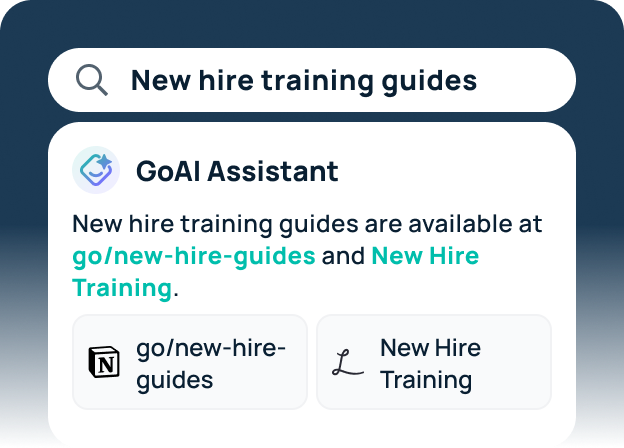
AI Collaboration Platform FAQs: What Buyers Ask Before Choosing
What’s the difference between an AI collaboration platform and enterprise search?
Enterprise search helps employees find information across company systems. An AI collaboration platform also summarizes what it finds and acts on it through agents and workflows. Choose enterprise search if employees mainly need to find information, such as documents, messages, tickets, or CRM records; choose an AI collaboration platform if they also need follow-up actions across apps.
How do AI collaboration platforms differ from project management tools?
Project management tools organize defined work, such as tasks, projects, owners, deadlines, and dependencies. AI collaboration platforms are broader: they help employees find and understand information across multiple systems and can use that context to support or automate follow-up work.
Is an AI workplace assistant the same as an AI collaboration platform?
They overlap, but they’re not the same. An AI workplace assistant answers questions and drafts content for one person. An AI collaboration platform does that across all of a company’s apps and also takes action, such as creating a ticket or updating a record. GoSearch works as both.
Which AI collaboration platform works with Slack, Google Drive, and Confluence?
GoSearch, Glean, and Slack AI (on the Enterprise+ plan) all search across Slack, Google Drive, and Confluence. GoSearch also runs workflows across them, such as creating a Jira ticket from a question asked in Slack.
What is the best AI collaboration platform?
It depends on your main use case. GoSearch fits teams that need search, AI agents, and automation across many apps; Glean fits large-scale knowledge discovery; and Microsoft 365 Copilot fits Microsoft-first companies. Project tools (Asana, ClickUp, monday.com), Slack, and eesel AI each fit a narrower need.
What is the best AI workplace assistant for productivity?
It depends on where your work lives. Microsoft 365 Copilot fits Microsoft-first companies, Gemini Enterprise fits Google Workspace companies, and Slack AI and Notion AI fit teams centered on those tools. GoSearch fits companies that need one assistant to search, summarize, and act across many apps.
How long does it take to deploy an AI collaboration platform?
Timelines depend on the number of connectors, permission complexity, and rollout plan. Ask each vendor for a reference customer of similar size, and run a proof of concept on your three most-used apps before committing.
What is the ROI of an AI collaboration platform?
Estimate ROI from the time your own employees save, not from a vendor’s or analyst’s published average. Multiply headcount by hours saved per employee per week, then by your fully loaded hourly rate and working weeks per year. A 50-person team saving two hours each per week recovers roughly 5,000 hours annually; what that is worth depends on your rate. Track adoption rate, time saved per employee, and the share of agent output that ships without rework.